-Political geography of Maneh and Samalqan counties:
Maneh and Samalqan County is located in the northwest of North Khorasan Province, centered on the city of Ash Khaneh, and is bordered by Bojnourd County to the north and east, Jajarm County to the south, and Golestan Province to the west. The distance between the center of Maneh and Samalqan County and Mashhad is 280 kilometers and 40 kilometers to Bojnourd. This county, with an area of 4,898 square kilometers, has 3 cities, 3 districts, 6 rural districts, and 133 settlements and places. The population of this county in 2011 was estimated at 10,3944 people.
-Natural geography of Maneh and Samalqan counties:
Maneh and Samalqan County is geographically divided into two parts: mountainous and plain. The mountainous part is mainly located in the south and southwest of the county, and the Qorkhord and Hassanbeg Mountains are located in this area. The plain part includes the west of the county and areas in the north and center of the county that contain population centers. The permanent flow of the Atrak River passes through the southern part of this county. In general, the presence of permanent water resources and fertile soil has made this county one of the main agricultural areas of the province. High relative humidity and bubbling springs have created dense forests and lush pastures in the southern strip of the county and the slopes of the Yaman Daghi mountain range.
-Historical background of Mane and Samalqan counties:
The presence of abundant natural resources in Mane and Samalqan counties has long attracted human populations and fostered brilliant cultures in the region. The presence of historical monuments from prehistoric to contemporary periods in different parts of this county indicates the continuous settlement of humans in this region. According to archaeological research, parts of Mane and Samalqan counties were first inhabited about eight thousand years ago, the remains of which can be seen on the Qala Khan hill in the Samalqan plain. This county was prominent during the Achaemenid period as part of the Parthian police department and was also of great interest during the Parthian and Sassanid periods. The dispersion of settlement areas, defensive castles, religious centers, and the discovery of Sassanid coins in different parts of the county are evidence of this claim.

Qala Khan Hill
Registration number in the National Monuments List: 1421
Location: Mane and Samalqan County, Resalat Village (Qalae Khan)
Qala Khan Hill is one of the largest and most important prehistoric settlements in Mane and Samalqan County, with a history of settlement dating back to the Neolithic period, about eight thousand years ago, and life continued there until the Sassanid period. In addition, traces of settlement during various Islamic periods have also been discovered on this hill. Archaeological excavations on this hill led to the discovery of the remains of a large Sassanid castle and a large number of clay jars and other ancient objects, which are now kept in the Archaeological Museum (Mofakham Building) in the provincial capital.

Espakho Collection
Location: Mane and Samalqan County, Espakho Village
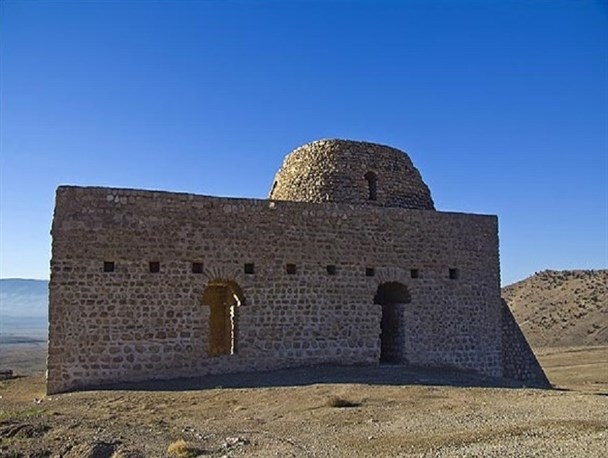
The historical complex of Espakho is located in a village of the same name, 61 kilometers southwest of the city of Ashkhaneh, the center of Maneh and Samalqan counties. So far, 14 historical monuments and sites have been identified in the historical complex of Espakho, including the Espakho building, the Shahr Sokhte castle, the historical mine, the tomb structures, the Sassanid castle, the Espakho site, the bathhouse, the old road, the Sassanid site, the old aqueducts, the Islamic site, and the Ali Asghar spring site. The most important and prominent monument in this complex is the stone building of Espakho, which is located on a relatively high hill south of the modern village of Espakho. This building, with an east-west longitudinal direction, consists of two different spaces: a square space under the dome, which is the main space (the hall), and a rectangular space called the porch. The overall dimensions of the building are 50/12 ×It is 21.40 meters high and in total the structure of the building can be divided into two parts: the dome house and the porch. In general, the outstanding architectural features of the Espakho building are a combination of elements and architectural styles of buildings from the historical era of Iran, especially the Sassanid era. Considering the location of this historical complex near the Gorgan-Bojnourd road, the most important goal in the research programs of this historical complex is archaeological excavations and converting the complex into an open-air museum site to introduce the historical attractions of the province and attract historical tourists.

Tomb of Imamzadeh Qasim, Bazar Qarnas
Registration number in the National Monuments List: 11129
Location: Maneh and Samalqan County, Qarnas Bazaar Village
The tomb of Imamzadeh Qasim is one of the religious-historical monuments of the Qajar period in the city of Maneh and Samalqan. The entrance porch is located on the eastern side and its roof is covered with a large arched arch, on the sides of which two spires with a height of 8 meters have been built.

Tomb of the Brave Imamzadeh
Location: Maneh and Samalqan County, 2 kilometers north of Ashkhaneh City
The tomb of Imamzadeh Delavar or Mohammad Dibaj is one of the holy sites in Maneh and Samalqan counties, the exact date of its construction is unknown due to repeated renovations. It is narrated that Imamzadeh Delavar was one of the descendants of Imam Reza (AS).