– Political geography of Shirvan city:
Shirvan city is located in the northeast of North Khorasan province and is bordered by Turkmenistan country from the north, Esfrain city from the south, Faruj city from the east and Bojnord city from the west. The distance from Shirvan city center to holy Mashhad is 195 km and to Bojnord city, the capital of North Khorasan province, is 52 km. This city with an area of about 3904 square kilometers has 2 cities, 3 districts, 9 villages and 169 villages. The population of this city in 1390 is estimated at 15,7014 people.
– Natural geography of Shirvan city:
Shirvan city was formed in Atrak river valley between Kope Dagh mountain range in the north and Aladagh mountain range in the south. The climate of this region is mild in summers and very cold in winters. Due to the presence of sufficient water sources, including the Atrak River and its numerous tributaries, agriculture is thriving in the region.
– Historical background of Shirvan:
Due to its suitable environmental and strategic location, Shirvan city has long been the focus of human populations and has been inhabited. The large dispersion of ancient sites from the prehistoric period to the Islamic period shows the importance of this region throughout history. Arg Naderi hill in the center of Shirvan city and Devin hill in Devin village are among the oldest settlements in Atrak river valley, whose settlement dates back to about six thousand years ago. In different parts of this city, the remains of settlements and fertile castles related to the Parthian and Sasanian periods have been identified, which probably formed part of an organized trade network that played a significant role in the cultural excellence of the province during the mentioned periods.

The ancient hill of Arg Naderi
Registration number in the National Monuments List: ۷۰۳
Location: Shirvan city center
The ancient hill of Arg Naderi is the largest ancient hill of Shirvan city, the history of its settlement dates back to the prehistoric period. Examining the works in this ancient settlement and especially the study of the pottery obtained from it shows relations with southern Turkmenistan about six thousand years ago. During the Islamic period, a fence with several towers was built around Garda Gard Hill, and for this reason, it is also known as Naderi Citadel.

Hanamah Caves
Registration number in the National Monuments List: 22214
Location: Hanameh village, 18 km northeast of Shirvan
Hanameh caves are made up of small spaces that were dug to create a village with a special defensive position in the heart of the mountain. This Dastkand architectural complex includes many residential spaces, warehouses, stables, etc., which are built with different levels and on three floors. The first floor was a barn or a place to keep cattle, and the second and third floors were a place for storing food and housing people. Based on the study of pottery found around this complex and comparative studies, Hanamah caves were built in the 4th-5th centuries of Hijri and were used in later periods, especially during the times of chaos and insecurity.

Tomb of Imamzadeh Hamzah Ibn Musa al-Reza (AS)
Registration number in the National Monuments List: 704
Location: City of Ziarat
Imamzadeh Hamza Reza’s tomb is one of the blessed places and historical places of Shirvan city, which is located in Ziarat village and is attributed to Hamza Ibn Musa Al-Kazim, one of the brothers of Imam Reza (AS). This building has a rectangular plan and four entrances in the main directions. The external walls of the building are decorated with arched arches and the main entrance porch on the south side is tiled. The date of construction of this building is not exactly known, but according to the type of plan, facades, and the way the dome, arches, and arches were executed, it was most likely built in the Safavid period and was repeatedly repaired later.

Four Timurid arches
Location:
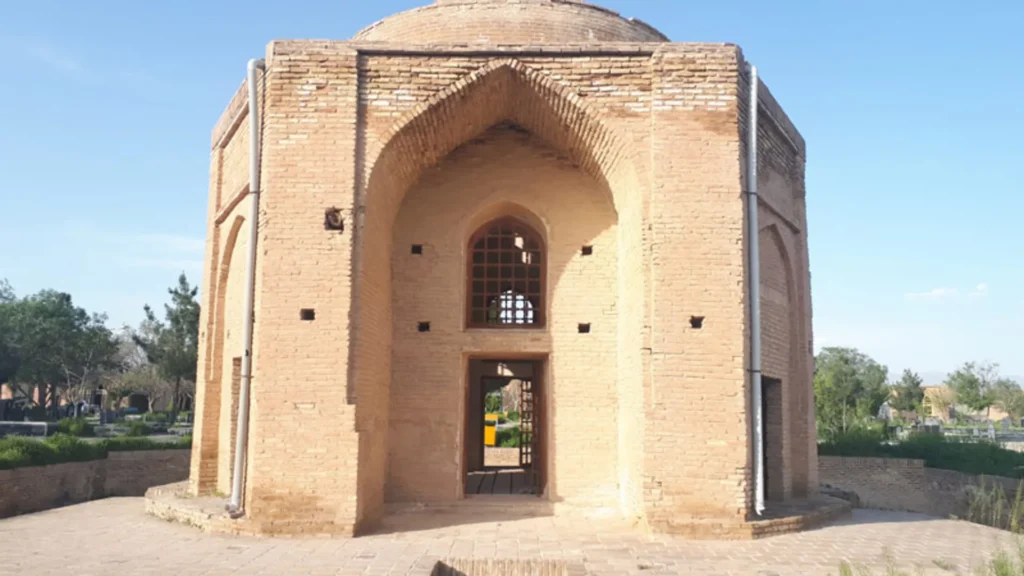
The four-arched Timuri historical monument is located 6 km from Shirvan. This tomb is attributed to Eid Khawaja, one of Timur’s generals. The building of the Timurid tomb has an octagonal view from the outside and a quadrangular plan from the inside. The geband of the building is of the detached two-layer type, and its external coating has been lost in the past years. Various elements, such as arches with gable cover and straight brickwork in the stem of the dome, have decorated the exterior of the building. The inside of the building is covered with plaster, which is decorated in different parts with unique paintings with hunting scenes and plant motifs. Also, under the skylights at the bottom of the dome, a strip of beautiful plaster inscriptions in Tholt script with the theme of verses from Surah Al-Imran has given this building a special effect.
Tomb of Prophet Zachariah (PBUH)
Location: Namanloo Village
The tomb of Imamzadeh Zakaria is located 70 kilometers northeast of Shirvan city, between Namanlu village and Golul region. According to ancient traditions and oral literature, the head of Prophet Zakaria was buried in the tomb and his body was buried separately at a close distance from the main court. The people of Namanlu and the surrounding villages, as well as some from other parts of the city, go to the shrine of Zakaria (PBUH) on one of the summer days to perform an ancient ceremony, and on top of the peak and next to the tomb, they hold a thanksgiving ceremony to harvest their crops. In this ceremony, people make sacrifices, vows, and needs to express their gratitude to the blessed and infinite Yezidi singer, thus displaying one of the oldest and most beautiful Iranian-Islamic customs.

Pir Shahid Bath
Registration number in the National Monuments List: 8942
Location: Shirvan County, Pir Shahid Village
Pirshahid bath is an example of a vault bath and consists of three main parts including a dressing room, hot room and hot and cold water vault. The dressing room is a vestibule with a twelve-sided plan, which is reached through a series of stairs. On each side of the dressing room there are shelves for placing things. From the eastern corner of the dressing room, you can reach the warm house. This part also includes 6 rectangular spaces, the length and width of three large spaces are 8.4 x 5.5 meters and three smaller spaces are 8.4 x 3.4 meters. The hot house is located in the eastern corner of the bathroom, and two smaller spaces are also used as safes. Hammam Pir Shahid is built below the ground level like other treasure baths.